Thursday, May 3, 2012

13 WATERFALL


The decision was made to reintroduce the water feature on hole 13. This definitely enhances the club's entrance way.  Once the preliminary plans were posed, we went to task to complete the waterfall. After a few setbacks the falls were turned on last Wednesday to great relief and jubilation!!  Here are few pics which chronicle the installation.


Day lighting the 6" pipe and reshaping the stream

Installing the liner

Laying the sod

Designing and building the pump sled.

The pump and sled ready to dive. This will aid in service removal.


COMPLETION!


Wednesday, May 2, 2012


I have been asked a few times recently, why did you go out and beat up the greens after they finally healed from aerification? The Graden process we performed on the greens earlier this year sliced a channel about 1 to 1 1/2 inches down. This does a great job removing the dense top layer, but we must also open channels deeper into the soil profile. The Verti-Drain machine accomplishes this using a 3/8" X 10" solid tine to reach down 7-9 inches. These spaces allow for air and water to penetrate and gives a place for the roots to grow. The deeper the roots can dive the better chance for survival during the hot summer months.

Monday, March 5, 2012

Drilling for water

Today we began the well drilling process on #3. Our hydrologist believes that sufficient water can be found somewhere between 300 and 500 feet down. Today they reached a point of 320 feet and the bottom drill snapped in half, halting the operation. Tomorrow, they will bring out a heavy duty magnet to try and pull that piece out and continue drilling. After they find sufficient water, we will hook up a pump to test water. Once the water quality and quantity is verified, the well stability needs to be checked and we are in business for summer!

The tees will be placed on the forward tee for the remainder of the process. Thank you for your patience as we dig for a much needed resource.

Monday, February 20, 2012

Tree Maintenance


I hope you’ve all enjoyed the warm weather and been able to get out and play the course. If you have, you may have noticed that the maintenance staff has done some tree work. Trees complicate things on a golf course for several reasons and in this post, I will summarize the areas and explain the reasoning for tree removal.

Sunlight
One of the main reasons for tree removal is that it can create difficulties when it comes to maintaining turf. More specifically, they block a lot of sunlight. Hence, we removed a substantial amount of them from the left hand side of #7 green. Allowing the plant to receive morning sun, especially during the spring and fall months is essential for photosynthesis. After all, this is when the plant is cultivating its root system for the summer and winter months ahead.

Damaged
A more obvious reason for tree removal is when they have experienced moderate to severe damage from insects or disease. We inspected nearly every tree on the course over the span of last season and believe we have adequately addressed this problem. One tree you may notice missing is a Green Ash on the right hand side of #15 green, which was rotted in the middle as well as heavily infested with Emerald Ash Borer. Another example was two white oaks, which we removed from the front of the Ladies’ tee on #9. These trees were slowly dying from the top down and presented a considerable hazard to the membership.

Aesthetics
We removed a limited amount of trees for this reason. Before the Club opened, we were unable to finish clearing out the small tree lines that lie adjacent to many holes on the course. This has been an ongoing project for the Club since 2005. An example is between #6 & #11 fairways where there were multiple small and medium sized trees. While the removal of these trees offer a cleaner look to the course, it will also allow golfers to take full back swings when hitting out of the area. Another benefit in their removal is that it will promote a healthier environment for the specimen trees in those areas.

Maintenance Efficiency
Pretty much from April to November, my staff is blowing debris and leaves off of the course. This not only is this very time-consuming and sometimes intrusive to the Membership, but it also negatively affects the turf in multiple ways. Furthermore, it takes a toll on our equipment. Therefore, some trees were removed which are continual nuisances throughout the year (Sassafras, Ash & Black Cherry).

Overall, I believe that the selective tree removal performed this past winter will provide great benefits to the course and, in turn, the membership. I fully expect to see enhanced turf conditions, lower operating costs and straighter shots coming out of the tree lines this upcoming season. 

This is Sunseeker, an app I found after we had removed the trees on number 7. The light blue line is the sun angle on the shortest day of the year, the red line in the corner is the angle on the longest day of the year, and yellow is today. You can see by the angle and time frame that the trees removed left of the large walnut trees give us a couple extra hours of sun in spring and fall. The walnut trees are next in line and will give us even more sunlight in the shoulder seasons and in turn healthier turf.
This image is off the back of 9 tee where we cut back the tree line to give the turf more sunlight in the summer. We gained about an extra hour of morning sun and the tree removed to the left of the tee gained us about an hour in the afternoon. This should allow the turf to dry out a bit more and survive through prolonged wet, hot periods.

Friday, February 17, 2012

Early Spring

The course is emerging well from winter (if you want to call it that). The fertility that was intended as a dormant feed to help the plant through winter and emerge healthier in the spring is ready to push. We have a couple nice days to finish out this week and it looks like after a brief cold spell, we have some decent weather heading our way. I had Michael set up a mower for us to try on Kramer's green and it looked perfect! With the greens having no frost layer, we will give them a cut at the end of next week and open them up for play. By us cutting the turf, it will stimulate growth and the plant will be able to handle the traffic with ease. We look forward to seeing you out there and cutting some grass!!

Tuesday, February 7, 2012

Winter Drawdown

I lowered the pond levels last week in an attempt to control cattails. By lowering the water level, the shallow edges where cattails thrive are exposed to the winter elements. Plants can be damaged by freezing, dessication, or even strong wind. I have been waiting for the weather to turn cold enough to control the plants, but don't know if we will see harsh temperatures this winter. These invasive plants are issues on the shallow banks of 18 and 3. We tried this method on 3 last year and had good results. With the new submersible waterfall in the pond on 18, we can draw the water out of the top pond very easily as well.
Once this invasive species gets a foothold in your ponds, it is very difficult to control. We have held our own so far, but I have a few quick facts to show you how fast in can take over. Cattails spread by seed, but also by rhizomes in the soil (you can see them in bunches near the banks). Each cattail plant contains nearly 250,000 seeds and the seeds can remain viable in the soil for 100 years. We also have chemical control methods available to keep them at bay, but lowering the water level is my first choice.

Tuesday, January 24, 2012

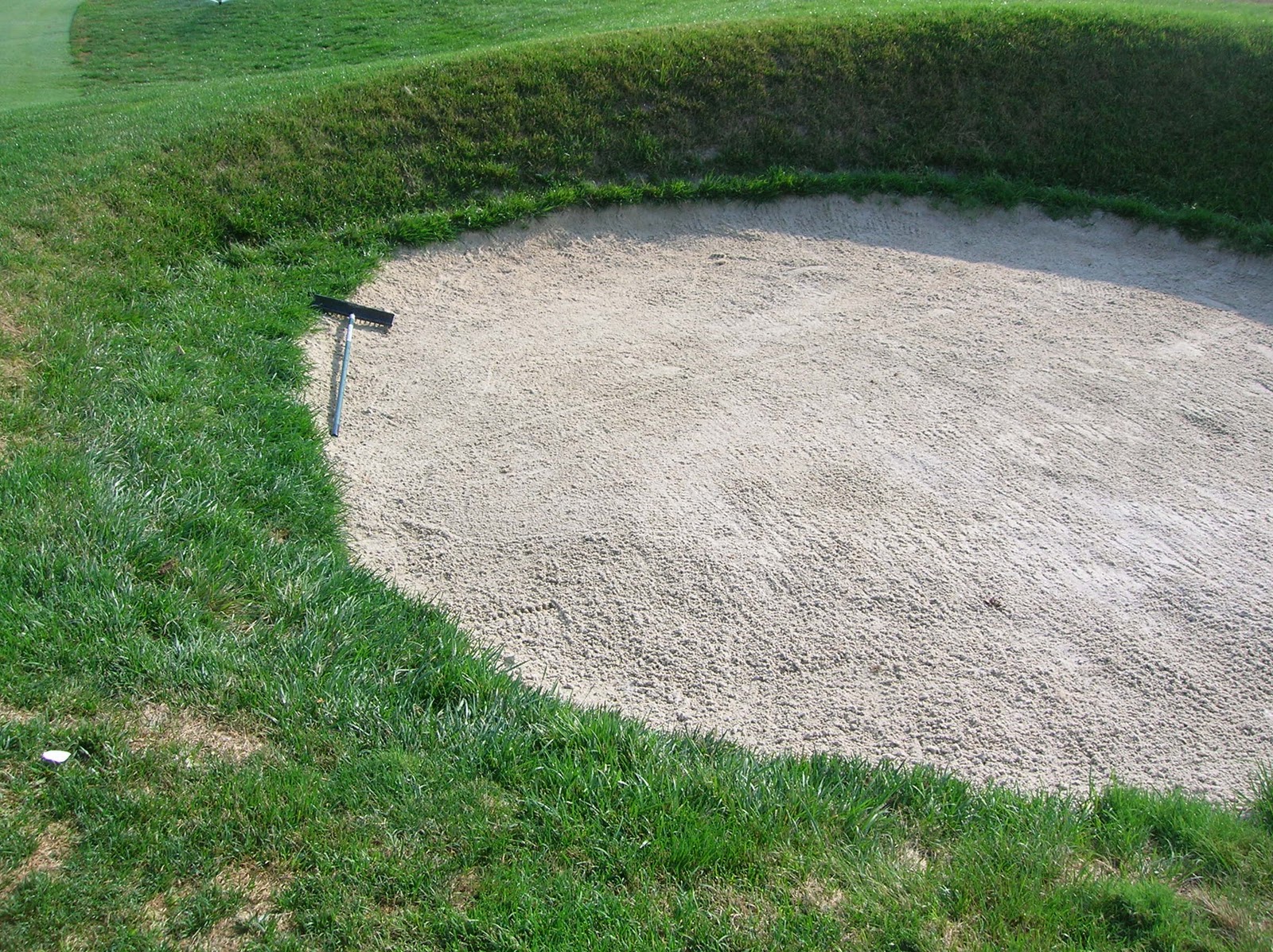
Bunker Edging

Many of the bunker edges had sloughed into the sand over the past eight years. We have limited machine traffic into the bunkers in the previous two seasons to help alleviate the damage and in December tackled it full force. Below are pictures of one of the worst bunkers on hole #2 before and after. The left edge had about a two foot lip and the back portion had a small shelf built to catch golf balls, leaving the golfer with some very unusual stance issues. We went out with pitchforks, edgers, shovels, and many good backs to tackle the worst areas. Our plan moving forward is to edge six holes every season to eliminate this issue ever building up again.