Sunday, December 22, 2013

Saturday, November 30, 2013
Course Update
The outstanding weather throughout November has given us a great opportunity to continue work on our bunker face rehab. Over the years, thatch and sand build up on the steep faces has contributed to the decline of quality grass in these areas. Starting last season, we started a rotation to strip/ resurface the bunker faces, eliminating patchy areas where golf balls wind up causing difficult recovery shots.
 |
| 1 Bunker face in fall of 2012 |
 |
| After resurfacing last year. Fall 2013 |
 | |||
| #7 Greenside. After removing layers of thatch and sand. |
 |
| #7 Finished |
 |
| #9 Before |
 |
| Completed |
 |
| The lip created on 14 greenside after 10 years of bunker shots! |
 |
| Ah ha, that's where my sand budget goes! |
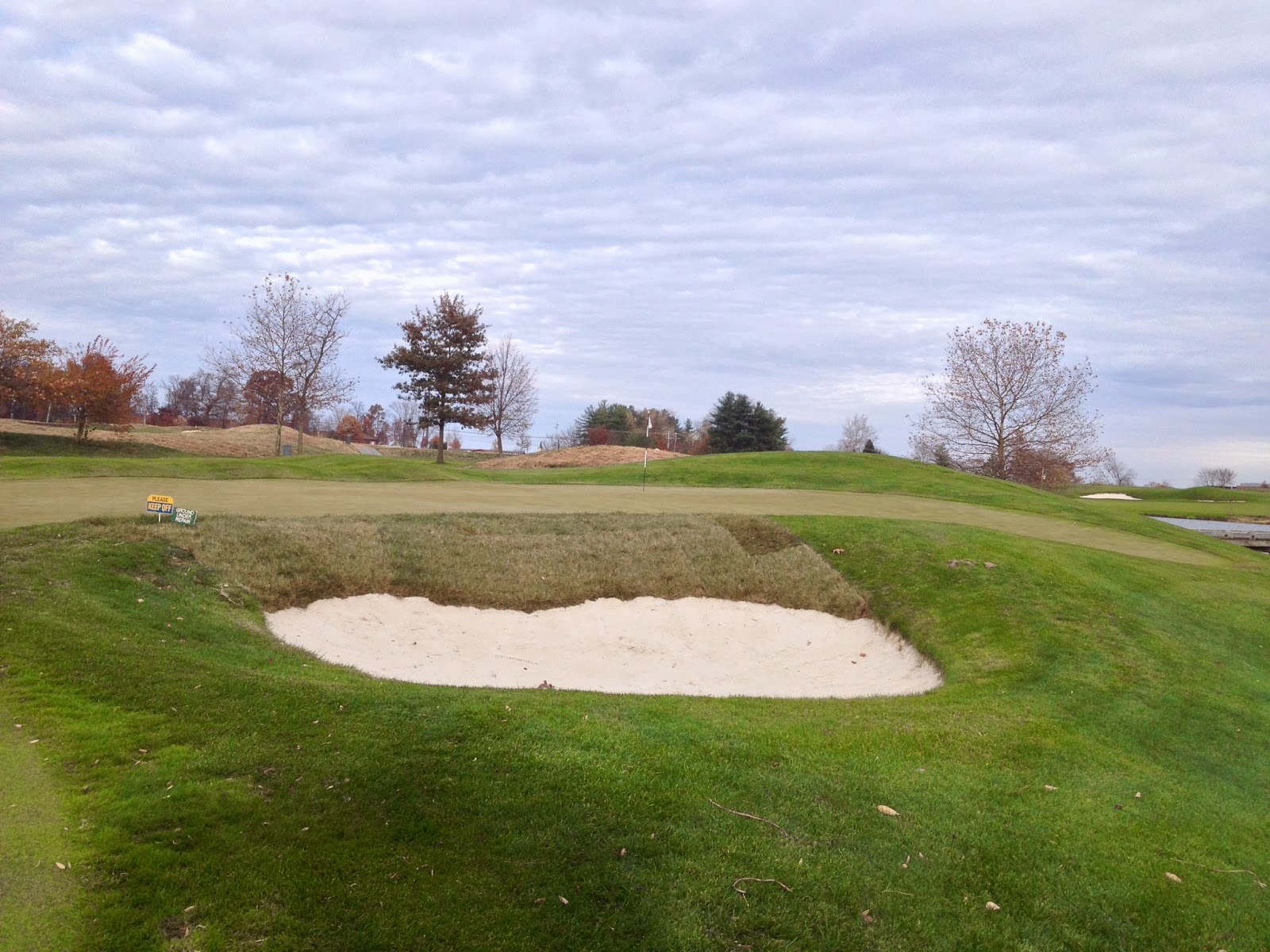 |
| Back to original form |
Tuesday, September 24, 2013
What happens when things go wrong II
There's never a dull moment here at Rivercrest. While prepping the greens ahead of the Club Championship field so not to change the conditions through out play we experienced this major blow out! The lead group was on 5 green when this little glitch occurred. We frantically raced to the shop to get the squeegees and a cup cutter before the first group arrived while alerting Jamie on the first tee of the change. Whew, just in time.

 |
| This geyser almost took Mike's head off! |

| Of all places to drain to, right over the pin placement for the final day |

Just a Reminder

 Please save our cart path edges! Over the years a tremendous amount of time and energy has gone into fixing these areas. Excess compaction coupled with radiant heat are the main killers of grass along the path. Parking the carts away from the edge will greatly help our appearance. Thank you.
Thatch, Thatch and more Thatch
The bentgrass cultivars make for excellent golfing surfaces especially greens but have a drawback with being prolific thatch producers. Managing this layer is extremely important as bentgrass can create a .5" of thatch every season. This will lead to serious problems such as poor oxygen and water infiltration, frequent wilt from shortened root systems, and eventually black layer. Black layer is a mass of decomposing thatch and organic material that is completely oxygen deprived and will quickly lead to surface death if not corrected. The dense thatch holds moisture at the surface causing the roots to shrink as there is no need dive in search of water. With excess rainfall this year punching the greens and tees more often was necessary to allow a path for roots to follow but more importantly, introducing oxygen below.


The tees have been cored twice this fall to aggressively attack this layer. To keep the tees looking healthy and improve recovery throughout the season increased amounts of nitrogen are applied but with the downside of producing more thatch. We will attack this layer early next year as well with two aerifications in the spring.
Friday, August 23, 2013
2013 Fall Aerification
Monday's aerification went exceedingly well with overcast
skies, cool temps, and the crew raring to go. After 14 hours going strong,
all the greens and approaches were cored. The greens were punched using
1/4" hollow tines and 3/4" hollow tines for the approaches. Finishing Monday was key as
hotter temps were arriving Tuesday and Wednesday. The less time spent
abusing the grass during the heat of the day would aid in recovery.
Topdressing and brushing was done first thing in the morning and early evening
to avoid the heat. This allowed us to concentrate on cooling/syringing
off the grass midday as temps hit 90 degrees.


 |
| Corey spreading wet topdressing at a heavy rate. |

 |
| Our new rotating brush in action. Even with heavy amounts of sand, two passes was all that was needed. See finished below |

Shade : Update
We took advantage of an opportunity while being closed for aerification to address the turf issues on nine tee. Arader Tree Service set up and removed three trees behind the back tee which will allow all important morning sunlight to hit these areas. We also removed a few trees directly to the left of the middle tee to get some midday sun. Opening up these areas will allow for more sunlight and airflow to reach the tees throughout the day. This will improve recovery especially during rainy periods as it will speed up the drying time.


 |
| 8:00 AM two weeks ago |
 |
| 8:00 AM this past Wednesday |
 |
| This picture was taken after coring the tee a few weeks ago. The water still remained in the thatch four days after a rain. |
Subscribe to:
Posts (Atom)